

Why Becoming a Developmental Organization Is No Longer Optional
Becoming the Organization the Future Requires
Organizations today are operating under conditions most of us didn't anticipate even a decade ago. Products become obsolete faster than roadmaps can track them, teams work across distance and difference, and leaders are expected to navigate challenges that simply didn't exist a few years ago. In this environment, a quiet realization is spreading: traditional management isn't just struggling, it's showing its fundamental limits.
Hierarchies struggle to adapt to complexity, causing widespread burnout. Innovation often stalls not because people lack skill, but because they lack the inner capacity to meet the pace of change. Becoming a developmental organization is no longer a “nice to have” - it is a necessary response to the world we are living in.
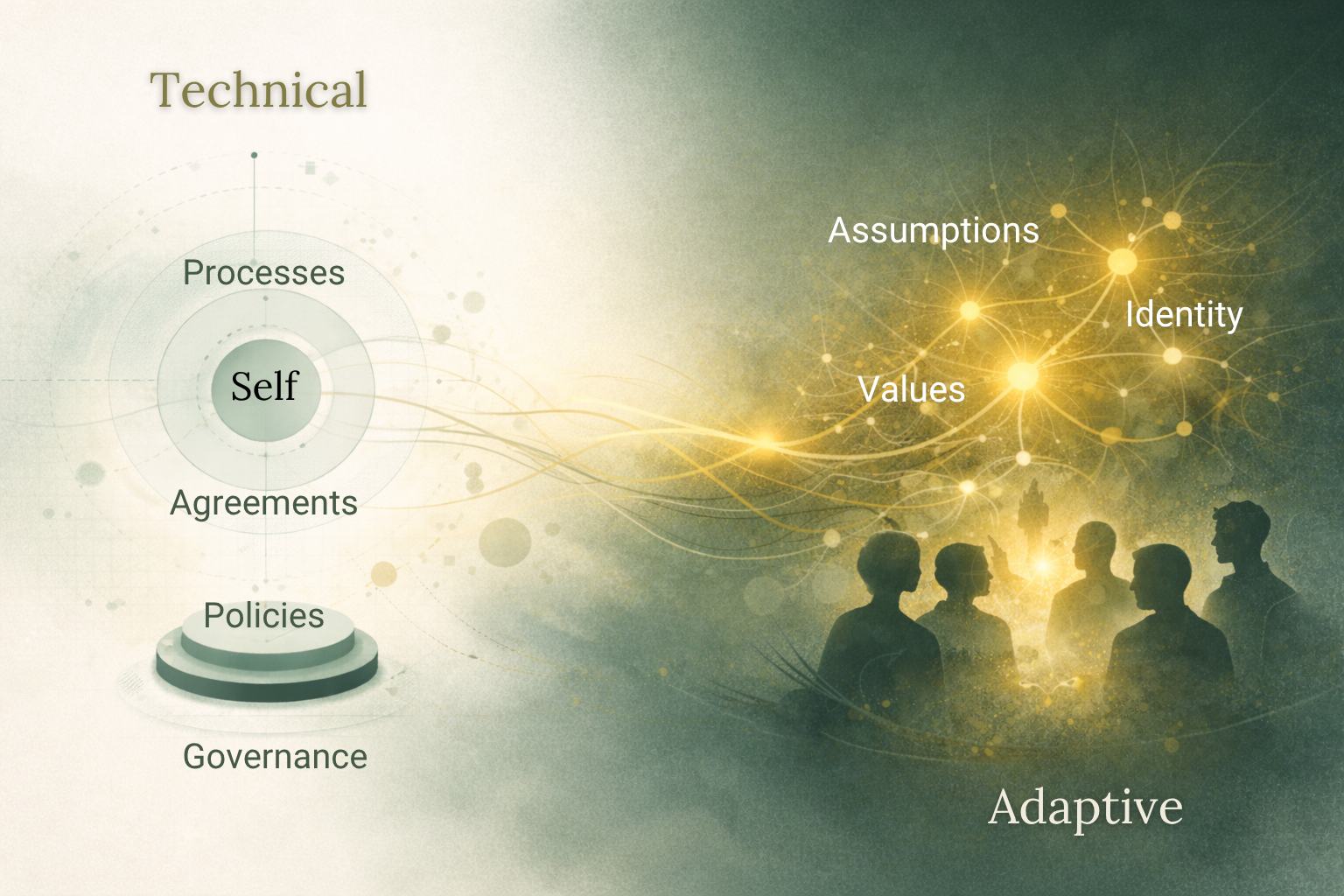
While new structures and processes can help, many of today’s challenges are not technical in nature. They are adaptive. Adaptive challenges require changes in behavior, mindset, and internal capacity, not just better execution of existing strategies. This is where the concept of a developmental organization becomes relevant.
From Structural Change to Developmental Capacity
Twelve years ago, moving with my family to Portugal was driven by a desire to live more consciously and in alignment with the kind of world I want to help create. Along that path, I encountered Sociocracy not simply as a governance system, but as a powerful structure for empowerment, shared leadership, and regenerative ways of working. It gives organizations a real mechanism for responding to change by accessing the collective wisdom of members and maintaining agency without losing accountability.
However, as a Sociocracy Consultant, I quickly discovered that implementing a power-sharing structure alone does not automatically lead to empowerment. And as a Leadership Coach, what became clear is that organizational change and personal growth are inseparable.
As Otto Scharmer of the Presencing Institute reminds us, “The success of an intervention depends on the interior condition of the intervenor”. In other words, the effectiveness of any intervention depends largely on the internal state of the people involved. Organizational structures can enable new ways of working, but they cannot substitute for the inner capacities required to use them well.
Technical Problems and Adaptive Challenges
One of the most important distinctions for organizations today is the difference between technical problems and adaptive challenges. Technical problems can be addressed with expertise, processes, or tools. Adaptive challenges require people to learn new ways of thinking and relating, often involving changes to identity, values, and assumptions.
Many of the issues organizations face today, such as burnout, disengagement, misalignment, and slow decision-making, fall into the adaptive category. Addressing them requires more than efficiency improvements. It requires increasing individual and collective self-awareness, emotional regulation, and the ability to work with uncertainty.
Developmental organizations intentionally invest in building these capacities alongside formal structures. They recognize that adaptability depends on both external systems and internal skills.
The Role of Invisible Culture
Even in organizations that adopt collaborative governance models like Sociocracy, informal and often unconscious patterns continue to shape behavior. I call this the invisible culture - the habitual tendency to avoid conflict, to self-protect, or to withhold uncertainty for fear of how it will be received.
Research in adult development suggests that many professionals spend a surprising amount of energy managing appearances at work: concealing weaknesses or sidestepping situations that might expose what they don't know. This is entirely understandable and how we’ve been trained to show up. My father used to always say, “don’t mix business and pleasure”. The sub-text was, “being yourself isn’t professional”. But this stance comes at a serious cost. When people are busy hiding, they aren't learning. Creativity narrows, and the cognitive and emotional load quietly accumulates.
Adult development psychologists Robert Kegan and Lisa Lahey suggest that burnout is often linked less to workload and more to a lack of vitality, i.e.the exhaustion of maintaining these invisible defenses. When people cannot bring their full selves to work, organizations pay the price.
Development as an Organizational Capability
Developmental organizations approach growth as a shared, systemic process rather than an individual responsibility. This involves creating environments where learning is normalized and supported through regular practices, such as feedback processes, peer learning, coaching, and reflection. In a developmental organization, weaknesses are not liabilities. Instead they are learning edges where personal growth becomes a shared responsibility rather than a private struggle.
Trust plays a central role in this approach. Without sufficient psychological safety, individuals are unlikely to surface uncertainties or experiment with new behaviors. Developmental organizations therefore focus on embedding practices that support transparency and mutual accountability, rather than relying on informal goodwill alone.
Kegan and Lahey are careful to note that development has to happen alongside business imperatives. Growth cannot be an “extra” activity; it must be woven into how decisions are made, how tensions are processed, and how success is defined.
Creating Conditions for Learning and Adaptation
Rather than attempting to predict or control outcomes in an unpredictable world, developmental organizations lean into experimentation and iteration. They use feedback loops to learn from practice and adjust course as conditions change. Tensions are treated as information rather than problems to eliminate. This approach pairs very well with Sociocracy, which also leans into the idea of tensions as opportunities for learning and where feedback is embedded in daily work.
Culture, in this context, is understood as dynamic rather than fixed. As individuals develop new capacities, organizational culture shifts accordingly. The focus is therefore on creating conditions that support ongoing learning rather than achieving a static ideal.
Why Developmental Organizations Matter
As the external environment becomes more complex, organizational success increasingly depends on internal adaptability. Developmental organizations, combined with Sociocracy, provide a framework for building that adaptability by addressing both the structural and human dimensions of work.
By investing in self-awareness, relational capacity, and shared learning alongside effective governance structures, organizations are better equipped to respond to change, make sound decisions, and achieve sustainable resilience.
In this sense, becoming a developmental organization is less about adopting a philosophy and more about developing a practical capability: the ability to learn continuously in a changing world.
Learn more about adaptive and technical challenges in organizations: