

Same Prison, Different Walls: Why Governance Alone Cannot Save Your Organization
A central question I sit with in my work is this:
How do we respond to what is being asked of us when everything is constantly changing, and the old ways of working are no longer effective?
Many organizations are grappling with this question. We are operating in conditions often described as VUCA (volatility, uncertainty, complexity, and ambiguity). While these conditions have always existed to some degree, they are now far more visible and tangible. Systems we once relied on for stability are breaking down, and the pace of change continues to increase.
Organizations must learn how to function and learn under conditions of ongoing disruption. Adaptability is essential in this context and lays the foundation for how organizations respond to change and create a desirable future.
Becoming an Adaptive Organization
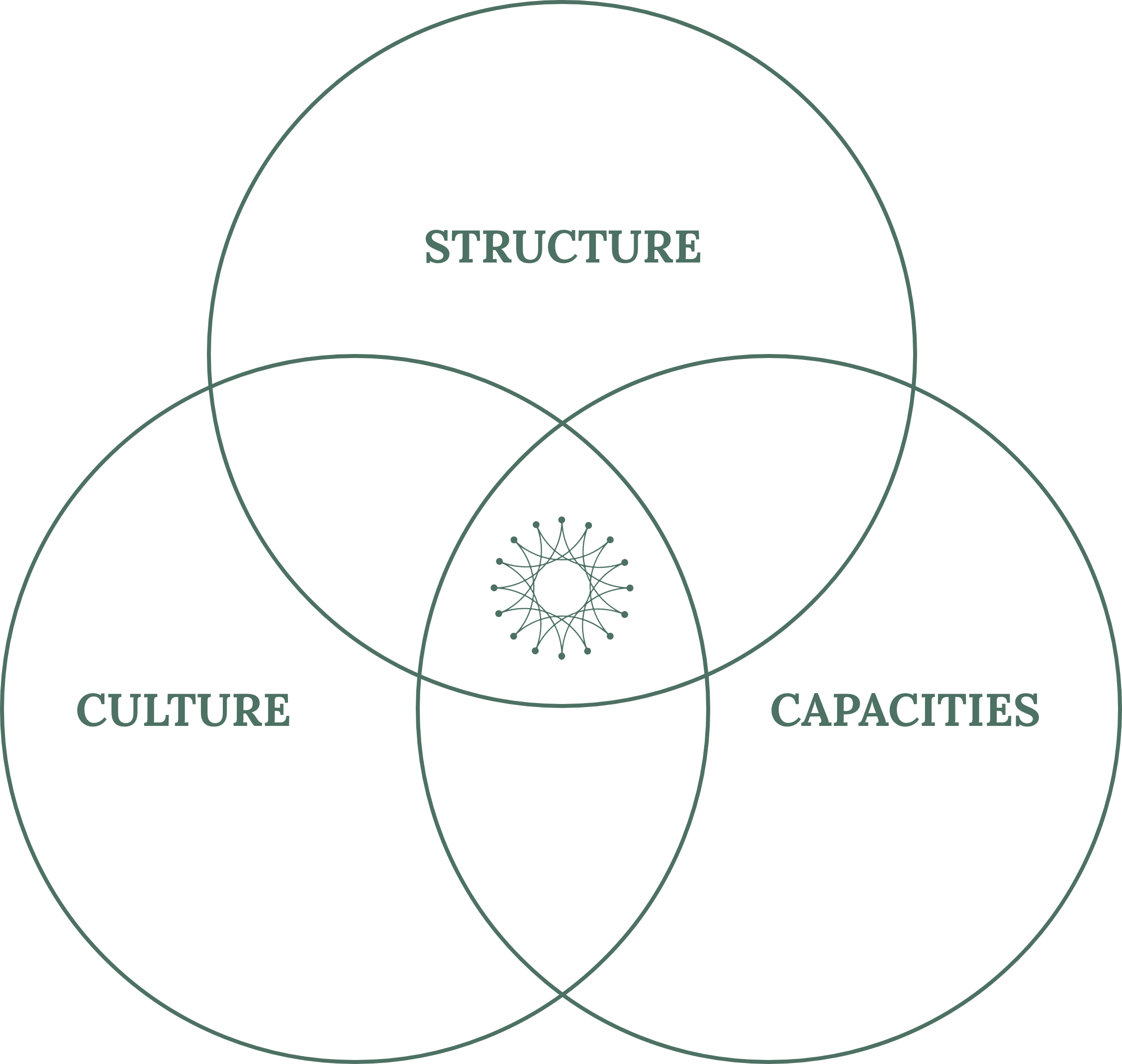
I use a three-fold approach to support organizations in becoming more adaptive:
Structure: governance, roles, decision-making processes
Culture: shared norms, expectations, and relational agreements
Capacities: individual and collective abilities such as self-awareness, communication, and emotional regulation
When these elements are integrated, organizations are better able to self-manage, learn, and adapt. Adaptive capacity emerges when all three are developed in parallel.
Structure: Power-With Systems
The structural foundation of this model is Sociocracy, a self-managing governance system based on consent-based decision-making, clear roles, feedback loops, and distributed authority. Sociocracy creates power-with structures, which are systems designed to include multiple perspectives and enable shared responsibility. One of the core principles of Sociocracy is continuous learning and evolution, typically supported through regular feedback. However, becoming a true learning organization requires going deeper than feedback and retrospectives. Through examining how people, individually and collectively, learn and grow over time, adaptive resilience is continuously built.
Culture and Capacities: Power-Within
Although Sociocratic structures facilitate collaboration and power-with dynamics, years of experience have taught me that they are not enough on their own. These structures can be difficult to sustain when not enough attention is paid to culture and capacity. We run the risk of reproducing old power dynamics and relational patterns, even within the new forms. I refer to this as “the same prison with different walls.”
Each of us brings learned behaviors, relational patterns, and beliefs into our work environments, which can be shaped by schooling, past workplaces, family systems, and lived experience.. For power-with structures to function effectively, they must be supported by power-within capacities. Power-with structures involve cultivating an environment that allows (and encourages) individuals to participate consciously, take responsibility, and engage constructively with tensions and uncertainty.
What Is an Adaptive Organization?
I define an adaptive organization as one that:
Embraces change and drives innovation
Understands the central role of culture and learning in shaping success
Proactively adjusts strategies, structures, and processes in response to shifting conditions
Nurtures personal development, collaboration, and resilience
Recognizes that organizational challenges fall into two distinct categories: technical and adaptive
Adaptive challenges usually involve underlying beliefs, behaviors, and/or assumptions. They surface through the subconscious and require a degree of self-awareness in order to battle the internal resistance that comes along with them. Adaptive challenges differ from technical challenges, which are typically well-defined linear issues that are solvable through skill building. (Learn more about the difference between technical and adaptive challenges).
Adaptive challenges, therefore, require conditions that support developmental learning at the individual and collective level. These include:
Psychological safety that allows people to stretch beyond their comfort zones
Trust that supports experimentation and learning from failure
A willingness to engage with uncertainty and change habitual patterns of self-protection
Practices that encourage people to surface learning edges rather than hide limitations (One of the best processes for this is Kegan and Lahey’s “Immunity to Change™”)
This represents a significant shift from traditional workplace norms, where professionalism has often meant minimizing vulnerability and hiding mistakes - a mindset that comes with the high cost of missed learning, diminished innovation and slower collective evolution.
Trust and Transparent Agreements
Developmental work requires people to make aspects of their learning visible. However, this is not natural for most of us! It runs counter to deeply ingrained patterns of self-protection and fear of exclusion. Therefore, trust within an organizational team becomes almost sacred. Without trust, visible learning becomes almost impossible. Trust in particular cannot be assumed; it must be intentionally cultivated through clear agreements, consistent practices, and shared accountability.
One practical tool that supports building trust is what I call “Ways of Working Agreements” (WoW). This is a written agreement that makes explicit what it means to work together more consciously and developmentally. This goes beyond operational agreements to include shared expectations about transparency, learning, and personal responsibility. When people understand the agreement they are entering into and the intentions behind it, they can make informed choices about participation and engagement.
Ways of Working agreements focus on how people relate and work together, rather than what the organization does. They are distinct from bylaws or constitutions, which govern structure and decision-making authority. WoW agreements function as a social contract that makes implicit expectations explicit.
A WoW Agreement typically addresses areas such as:
Embedded learning and development
Self-awareness and self-management
Inclusion, diversity, and power dynamics
Communication and feedback
Collaboration and accountability
Psychological safety and trust
Conflict resolution and handling tensions with care
Unlike policies, WoW agreements are not enforced. Instead, they serve as a shared reference point that teams can return to when tensions arise or alignment breaks down. In practice, they can make a meaningful difference, especially during moments of stress or conflict. Teams that have invested time in articulating how they want to work together often find it easier to address breakdowns directly, rather than defaulting to withdrawal or blame.
In one organization I was working with, a significant breach of trust occurred shortly after completing their WoW process. Rather than leaving the organization (which, previously, would have seemed like the right course of action), a key team member chose to address the issue directly, referencing the group’s shared agreements around trust and transparency. The existence of the agreement did not prevent conflict, but it provided a foundation for navigating it constructively.
Values, Principles, and Context
One common question is how Ways of Working agreements differ from values or principles. Values often remain abstract and context-free, making them difficult to apply in day-to-day interactions. As Sociocracy for All co-founder and author Ted Rau has argued, values and principles become meaningful only when interpreted within a specific situation or context.
Ways of Working agreements are therefore descriptive rather than prescriptive. They articulate how a particular group intends to work together, given their context, rather than asserting universal rules. This makes them adaptable and easier to engage with in practice.
Cultivating Resilience
I have found that the world we are operating in requires more than efficient processes. It requires conscious participation from a completely different set of reality markers than we’ve previously known. In my life and in my work with clients, I am realizing that many of my perceptions and assumptions have been shaped by years of distortions and deviations that undermine authentic empowerment. My clients and colleagues are feeling this too. We are seeing that true resilience is not found in controlling outcomes, but in how we show up for one another when the path is uncertain. As Otto Scharmer reminds us, "If you want to effect and impact outer change, you need to cultivate the interior dimension first. That's the leverage that will transform our relationships. And if we transform our relationships, we transform everything". Turning inwards to cultivate our capacity for self-management and emotional regulation is where individual and organizational strength truly blossoms.